
This is an investment service that assists people over the age of 70 ½ who have money in a qualified retirement account. The IRS requires everyone in this category to take a required minimum distribution or "RMD" out of their plan every year once they've reached the age of 70 ½. There are tables the IRS uses to determine the RMD each year as one ages. The first RMD factor in the most common table is 27.4 or approximately 3.65% of the Dec. 31st account balance. All custodians who hold and manage the assets have systems that will calculate the client's RMD each year.
Once the RMD is known the client then decides when and how to take the money out of the plan. One can usually take the distribution annually, semi-annually, quarterly or even monthly depending on the custodian's guidelines. The RMDRS maximizes distributions out while minimizing reinvestment costs in a new year. Moreover, reinvestments target those investments best suited to present-day goals and needs.
The advisor will assist the client through this strategy to make sure everything is arranged and executed. This idea will work using the client's existing retirement plan so the client doesn't have to move the asset. It also accommodates the client by doing everything on a systematic basis that can be changed, modified, or cancelled at any time with a phone call and two weeks advanced notice.
The RMDRS leads the client through the process from start to finish so that any client can rest assured that the IRS obligation is met, systematically and annually, the only adjustment is the amount the IRS requires be withdrawn, the RMD. Since the client is listed in our database, they will be automatically contacted to adjust the new year's RMD amount. The advisor then makes this adjustment with the receiving or new custodian who has the reinvested portion of the RMD.
Here is an example of the concept using an RMD date of December 6th and reinvestment date of February 1st. (See Exhibits 1-4A)
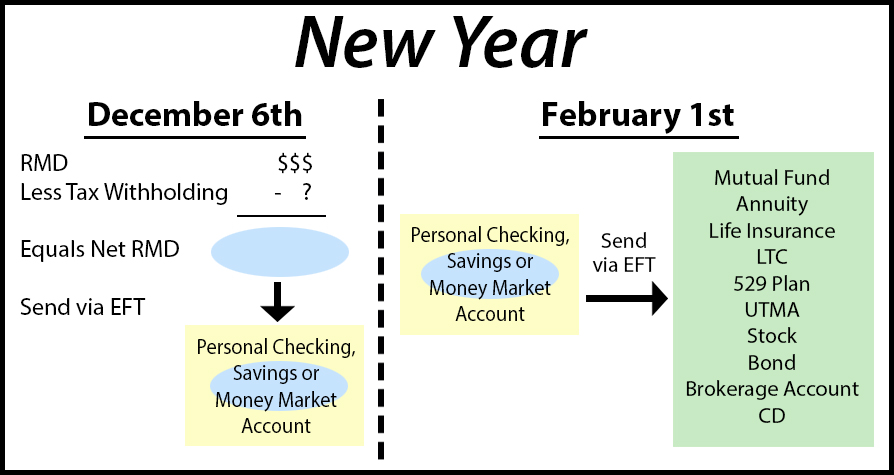
Keep in mind that once this is set up it happens automatically every year for the client's convenience. Also, everything is subject to change if need be. It's easily managed or modified with a phone call.
*The recommended draft dates above are based on research of RMD withdrawals for the past 15 years beginning in 2001. All things being equal for those past 15 years the findings show that when using the two dates recommended, portfolio balances are higher when selling and lower when buying than if other dates were used.* (See exhibits 1-4A)
Now we need to discuss goals and purposes for the RMD to assist the client on when and how to take money out of the plan and reinvest in a matter to best meet the client's goals and desires.
Goals/Purpose
The client has the flexibility to choose what to do with the RMD and the choices are very broad. The following are some investment options to consider: Mutual fund, an Annuity, Life Insurance, a college fund for children/grandchildren, UTMA account, long term care insurance, stocks, bonds, ETF's, or a brokerage account containing any or all of the above. With so many choices the RMDRS assists the client in meeting their wealth accumulation/preservation and legacy goals!
It is also important to note that if the RMD is "reinvested" with the same custodian who distributes the RMD, that purchase may be discounted at Net Asset Value since the custodian would consider it a reinstatement. The advisor will provide a letter of instruction to the custodian if this applies.
(See Exhibits 6 & 7)
Who Qualifies?
Anyone is eligible who owns a tax qualified retirement plan and has reached the age of 70 ½. Also, those who have inherited a plan requiring an RMD qualify. A sample list of those plans are as follows: 401(K), 403(B), 457 plan, simple IRA, traditional IRA, SEP IRA, TSP, and some pension plans. Although this isn't a complete list, it is a guide to assist in determining if one qualifies. If a client has one of these plans he or she is subject to the RMD and therefore also qualifies for this strategy.